When to Call a Rat Exterminator in Singapore?

Rat exterminator services are crucial because rodent infestation can wreak havoc in dense and tropical cities like Singapore. Apart from being a nuisance factor, rats are a threat to public health. From contaminating food and damaging wiring to triggering shutdowns and harming reputation, rodents are dangerous pests that require professional rat exterminators’ solutions for complete elimination. Yes, certain precautionary steps can help you keep these intruders at bay. However, watch out for clear red flags that mean you must stop at-home fixes and contact a licensed rat exterminator.
Through this blog, we will present facts and figures on rat infestations in Singapore to highlight why acting promptly (and professionally) matters a lot while dealing with rodent infestation. We also bring you the expert solutions of ORIGIN Exterminators that can be your best solution for rat control. Read along to determine how our techniques, data-driven and sustainable solutions align with NEA’s guidance.
Singapore’s Rat Reality: Facts and Figures
Rats may hide out of sight but the data does not. Here are a few highlights of how this pest remains a serious challenge in Singapore:
1. Burrow surveillance
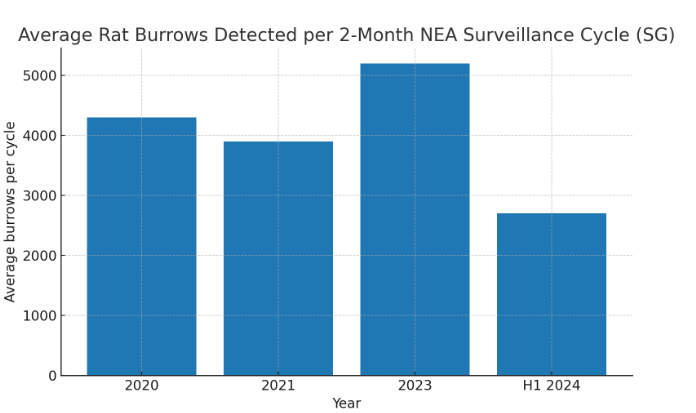
The NEA conducts periodic surveillance (every two months) to inspect rat burrows. The chart above visualises that burrow detections are improving, but not at a satisfactory rate. For instance, in 2020 and 2021, they detected an average of 4,300 to 3,900 burrows per cycle in public areas. The average burrow count shot to approximately 5,200 in 2023.
Since last year, the count has decreased; the first half of 2024 recorded about 2,700 rat burrows. However, the baseline needs improvement, especially in the construction-adjacent and waste-dense zones.
2. Stricter enforcement
To sensitise property owners and residents towards rat-related lapses, in 2024, NEA took more than 1,000 enforcement actions across Singapore. Moving forward, it announced stricter compliance measures in 2025, which target:
- poor housekeeping/ refuse management
- defects in refuse facilities
- presence of rat nests in the premises
Rats can cause greater harm than you can imagine. They transmit viruses that can cause murine typhus, hantaviruses and leptospirosis. In 2024, MOH’s Weekly Infectious Diseases Bulletin reported 62 human leptospirosis cases. Even the vet reports flagged numerous canine leptospirosis linked to rodent exposure and wet weather.
So, what do these findings indicate?
Rat activity in Singapore fluctuates and depends largely on the waste management, weather patterns and construction activities. The enforcement pressure has ensured some improvements, but there are imminent disease risks. Therefore, it is essential to escalate rodent sightings to professional rat exterminators before the infestation gets too large.
When to Call a Rat Exterminator in Singapore?
There are simple prevention tips (clearing food debris, sealing obvious entry-exit gaps, placing traps or baits, securing dustbin lids) that you can take to ward off these pests. But if you notice the following signs, you must promptly reach out to a licensed rat exterminator:
1. Multiple daytime sightings
Increased rodent activity, especially during the day, indicates an intensifying infestation with increased nesting. This also means that the store-bought baits or traps have failed to curb the population.
2. Increased signs of their presence
Dark, moist (fresh) droppings; new rub marks along pipes/walls; grease marks, and chewed cables largely signify an active route and feeding patterns. Professional rat exterminators will map their activity and disrupt them.
3. Harbourages and runs near refuse areas
Rat burrows or nests along open soil, planter beds and bin centres are definite warning markers. NEA’s strict enforcement, sharp focus on eliminating nest presence, and better refuse systems underscore why DIY will not work once the burrows appear.
4. Failed DIY attempts
If there are constant recurrences after using retail baits and traps, there is a hygiene or structural issue. These can be fixed only by professional-grade controls like Integrated Pest Management (IPM).
5. Food business or high-footfall premises
NEA expects supermarkets, F&B outlets, hawker-sites and malls to have a robust system to tackle rodent infestation by working with licensed providers. Not only is health at stake here, but even reputation. Plus, it can call for action with increased rat activity enforcement action.
How do professional rat exterminators function with the NEA-aligned approach?
In Singapore, any NEA-licensed rat exterminator will implement IPM. This typically includes the following:
- Survey and risk assessment: Map rat burrows/harbourage, species present, travel routes, food and water sources, and access points (entry exit points).
- Housekeeping and sanitation fixes: Cleaning routine, waste storage, grease management, and cleaning frequency.
- Proofing (exclusion): Seal spaces around pipe penetrations, fit bristle strips, employ roller shutters, and repair gnawable substrates.
- Targeted control measures: Employing snap traps or electronic units and professional baits in tamper-resistant spots. Usage of non-chemical methods to meet food or child safety in sensitive areas.
- Monitoring and documentation: Documenting an up-to-date log book with burrow maps, trend charts and service reports. These audits prove diligence in the case of an NEA inspection.
What Makes ORIGIN The Best Rat Exterminators?
Features like NEA-license, experience, evidence-driven, transparent policies, and audit-friendly reporting make ORIGIN Exterminators stand out in Singapore. Below are our key highlights that prove our competency in the modern rat-management programme.
1. RATSENSE surveillance system
We deploy an IoT system, RATSENSE, that is data-driven and tracks rodent activity in real time 24/7. Instead of the wait and watch and then set-trap practice, we follow the data procured from RATSENSE to target harbourage, adjust trap placements, and authenticate results. Our data trends are especially valuable in commercial spaces like logistics hubs, malls, and F&B clusters where reports or proof of extermination matters.
2. NEA-aligned IPM and documentation
Our programs are aligned with the auditors’ and NEA’s expectations. We pair our sanitization and proofing methods with clear targeted controls and strong reporting (that can save you from stricter fines).
3. Proven balance of sustainability with operational depth
We have proven our sustainable efforts by shifting our fleet to EVs. Our green practices have positioned us among the data-driven and eco-conscious companies.
4. PSG-approved digital rodent solutions for businesses
PSG supports hi-tech rodent control methods for eligible SMEs. The crux is to deploy digital control measures early so as to lower the barriers to availing smart monitoring that prevents costly investments. At ORIGIN, we promote Productivity Solutions Grant (PSG) approved rat extermination and control solutions in Singapore.
5. Experience in handling complex sites
From huge housing properties to commercial kitchens and multi-tenant establishments, we prioritise root-cause elimination of rodents (waste, proofing, and drainage). Plus, we emphasise continuous monitoring. These features make a combo that can guarantee fast knockdown and robust compliance.
Conclusion
Rats do not rest and neither do they let you. They bring daytime stress and nighttime noise. But these pests are more than just a nuisance. They carry health risks, property safety concerns, a threat to reputation and regulatory or compliance issues. While their numbers are declining, infestations in urban zones and areas with heavy waste remain a concern.
You may be able to deal with one-off sightings with some DIY solutions, but you will have to resort to professional rat exterminators to combat entrenched colonies. License providers like us work in tandem with NEA guidelines and expectations. Our transparent reporting and methods, like RATSENSE and IPM, satisfy both long-term rodent prevention and compliance requirements.
Finally, act early, do not wait, once you notice the alarming signs. Call an expert rat exterminator quickly, as a prompt response is often better and more cost-effective than a cure.
Call us now to avail a free consultation for your rodent-related issues. Protect your property or premises with ORIGIN’s proven and NEA-aligned rat control measures.